01
01Human direction
Sets value, defines the objective, accepts risk, and retains consequential authority.
03 · How it works
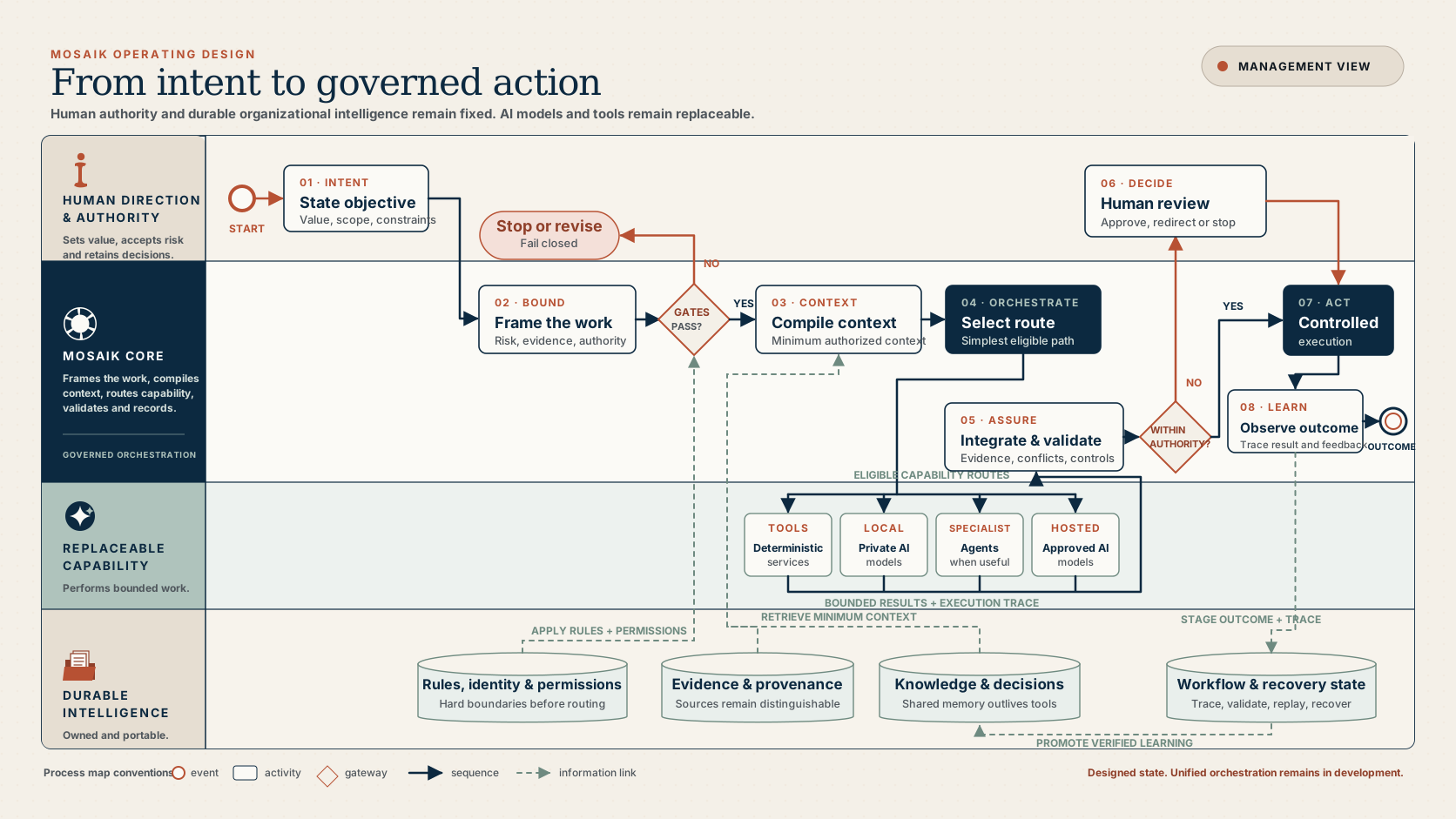
The process begins with a human objective, sends clearly defined work to the simplest capable and authorized tool, returns results through validation and human authority, and records what happened for learning and recovery.
01Sets value, defines the objective, accepts risk, and retains consequential authority.
 02
02Frames the work, compiles authorized context, applies gates, routes capability, validates, and records.
Tools, private models, agents, and hosted AI perform the bounded work they are eligible to handle.
Rules, evidence, knowledge, decisions, workflow state, and recovery remain owned and portable.
The operating discipline
The framework is the discipline beneath the process. Each word names a control that must remain visible as work moves from a human objective to an operational result.
Define the objective, permitted context, constraints, authority, and stopping conditions before asking a capability to reason. The system solves a named problem instead of wandering through an open-ended prompt.
Select the simplest eligible capability for the work. Privacy, risk, cost, speed, quality, and verification needs determine whether the route uses a deterministic tool, local model, specialist agent, or frontier model.
Carry evidence, provenance, permissions, validation rules, and human decision rights with the work. Capability can analyze or propose without silently inheriting authority to approve, disclose, or act.
Turn an accepted result into controlled action, then record the outcome. Trace, replay, recovery, and learning close the loop so execution strengthens the organization’s durable intelligence.
Four operating principles
Knowledge, decisions, rules, and history remain portable instead of becoming inseparable from one AI product.
Source evidence, interpretation, inference, proposal, and human decision remain distinguishable, so every statement carries a visible basis and level of authority.
Permission to analyze is not permission to decide, disclose, approve, or execute.
Validation, trace, replay, manifests, and rollback reduce dependence on one model, interface, or runtime.
The management view
The process map shows how the framework and four operating principles guide work across four fixed roles.